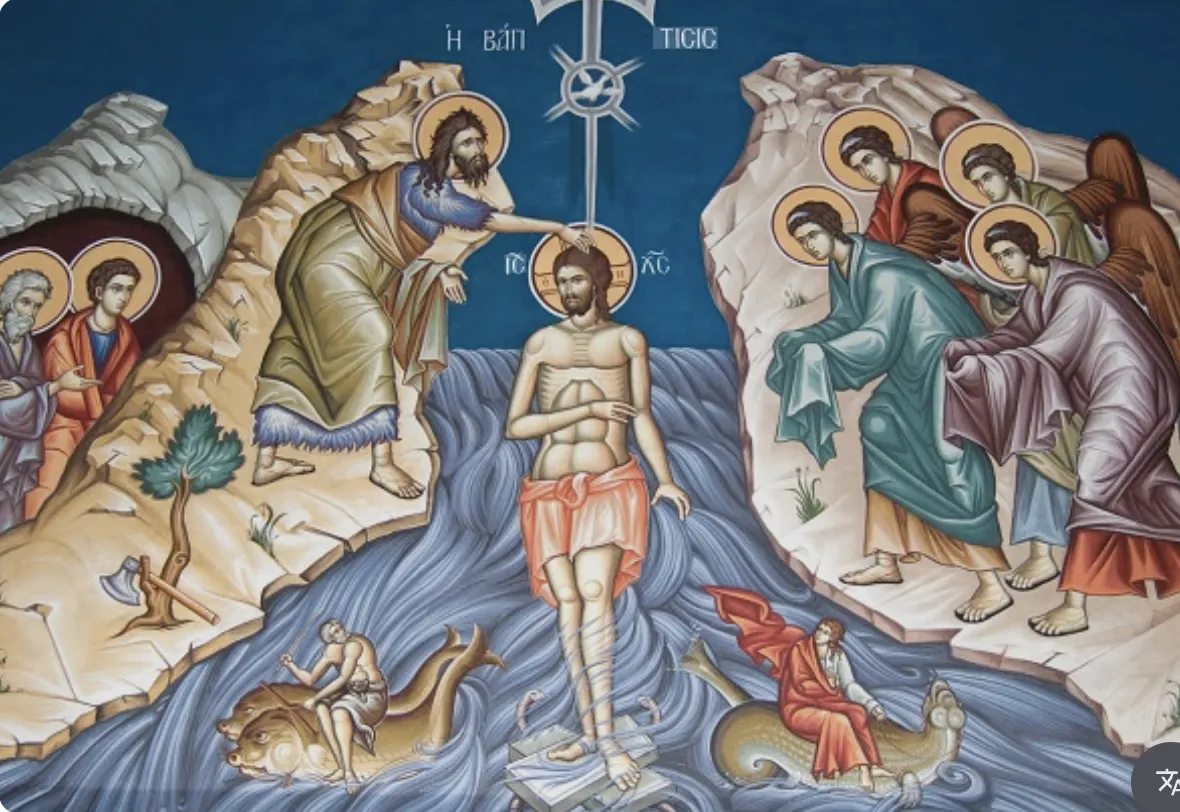
What Baptism Does
I recently had a long and lively discussion with a close friend about baptism. What is baptism? What does it do for us? Is it just a public display of an inward confession and belief? Is it “just a symbol”?
Before we get into baptism, I want to address a popular way of looking at things, especially when it comes to Christian practices such as baptism and communion. Saying “it is just a symbol” is assuming a couple of things. The first one is that symbols are just representations of something else, nothing more, nothing less. To be fair, symbols do represent, but they do not only represent. If we define a symbol by its ancient origin, it is how disparate parts come together and point us toward a higher meaning, as Jonathan Pageau at The Symbolic World never ceases to remind us. The second assumption is that when Christ commanded us to baptize in the name of the Father, Son, and Holy Spirit, he also saw it only as an outward sign or public proclamation of an inward reality.
What I find in the Scriptures when I read about baptism is language that leads me to believe that what we are participating in when we are baptized is far more than just a public act that symbolizes my confession. What I find is that baptism is doing something to and for us.
To begin, let us see what Jesus says about baptism. “Jesus answered, unless one is born of both water and spirit, he cannot enter the kingdom of God”(John 3:5). In conversation with Nicodemus about being born again, Jesus describes the circumstances of this new birth, through both water, which is baptism, and spirit, our indwelling of the Holy Spirit. In Peter’s famous speech in the second chapter of Acts, he tells the crowd, “Repent, and let every one of you be baptized in the name of Jesus Christ for the remission of sins, and you shall receive the gift of the Holy Spirit"(Acts 2:38). Just as Christ coupled water and spirit in the new birth, Peter also holds them as two parts of a single act, but adds the line “for the remission of sins.” Baptism, for both Jesus and Peter, is the way in which we participate in this new birth that is for the remission of our sins.
Building on this, in his first letter, Peter writes this about baptism: “And baptism, which this prefigured, now saves you-not as a removal of dirt from the body, but as an appeal to God for a good conscience, through the resurrection of Jesus Christ”(1 Peter 3:21). Peter makes this claim about baptism directly after he talks about how, when Christ was put to death, he descended into Hades and proclaimed the doom of the rebellious spirits there of the days of Noah. Peter then shifts to Noah and his family and their salvation through the floodwaters, specifically using the language “saved through water” (1 Peter 3:20). In the flood of Noah's day, the waters cleanse the world of all of humankind's wickedness. In the baptismal waters, we are not just cleansed on the outside, but our conscience is now cleaned, our sins being washed away. As we rise out of the waters, we join Christ in his resurrection (1 Peter 3:22).
Now let's turn to Paul, who adds yet another element to what is happening in our baptism. He says, “In Him you were also circumcised with the circumcision made without hands, by putting off the body of the sins of the flesh, by the circumcision of Christ buried with Him in baptism, in which you were also raised with Him through the faith in the working of God, who raised Him from the dead” (Colossians 2:11-12).
Circumcision is one of the earliest commands that God gave, even before the Law was established. It was more than a tangible sign distinguishing the Israelites from the nations. This was the ritual act that any male would undergo to signify their becoming a member of the family of God. This literal “cutting off” was an offering of what was most precious to carrying on of one’s lineage, a dedication of your family to God. When Paul compares baptism to circumcision, he talks about the “circumcision made without hands”, also referred to as “the circumcision of Christ.” Just as Peter brings up Jesus’s death when talking about baptism, so does Paul. The circumcision of Christ is his death and cutting himself off from the world by voluntarily dying on the cross. He took upon himself the curses of the law in his death, and through his victorious resurrection, cuts off the world, sin, death, and the demonic powers.
We, through the obedient act of baptism, participate in Christ’s death and all that it accomplished; it is how we receive the circumcision of Christ, which both puts off the body of the sins of the flesh and gives a clean conscience towards God.
The language that I see Christ, Peter, and Paul use about baptism is not making it out to be just a public declaration. What I see when I read their words is something far more meaningful and deep. It is a death that we enter into with our bodies, our minds, and our souls. It is for the forgiveness of sins, cleanses our conscience before God, puts death to our sinful bodies, and as we rise up from those blessed waters, we rise with Christ to a new life.
To say that baptism doesn’t do anything creates an unnecessary dichotomy between the material world and the spiritual. It downgrades what God is doing in the world, more specifically, through the baptismal waters. Furthermore, to court controversy, I don’t think this is a very Christian way of thinking about the world as a whole.
The world that God made was made to reflect his glory, meaning that it is not just stuff, collections of atoms and molecules. All of creation actually plays a role within the great story that God is writing. Paul says in Colossians that Christ reconciled all things to himself, whether things on earth or in heaven, through his work on the cross(Colossians 1:19-20). When Jesus was baptized in the Jordan, he blessed the waters of creation, especially the baptismal waters that we all enter into as members of his body. Romans 8:19-21 says that creation is eagerly waiting to be liberated from its bondage of decay and brought into the freedom and the glory of the children of God. To say that the waters aren’t doing anything is to reject the truth of these verses.
To end, I want to quote a line from the Nicene Creed, the historical and universally accepted confession of the Christian faith first formulated in 325 AD:
“I confess one baptism for the forgiveness of sins.”
I write this about baptism to make a case to return to a more ancient way of thinking. We like to get into discussions about salvation and what is absolutely necessary for it; usually, that turns into a discussion of the bare minimum one has to do to be considered saved, and often references the thief on the cross or other exceptional cases. This usually does not help us to take in and understand all that the Scriptures have to say about the practices that Christ handed down to us, like baptism. Christ gave us baptism because it is doing something to us and for us in our salvation journey.