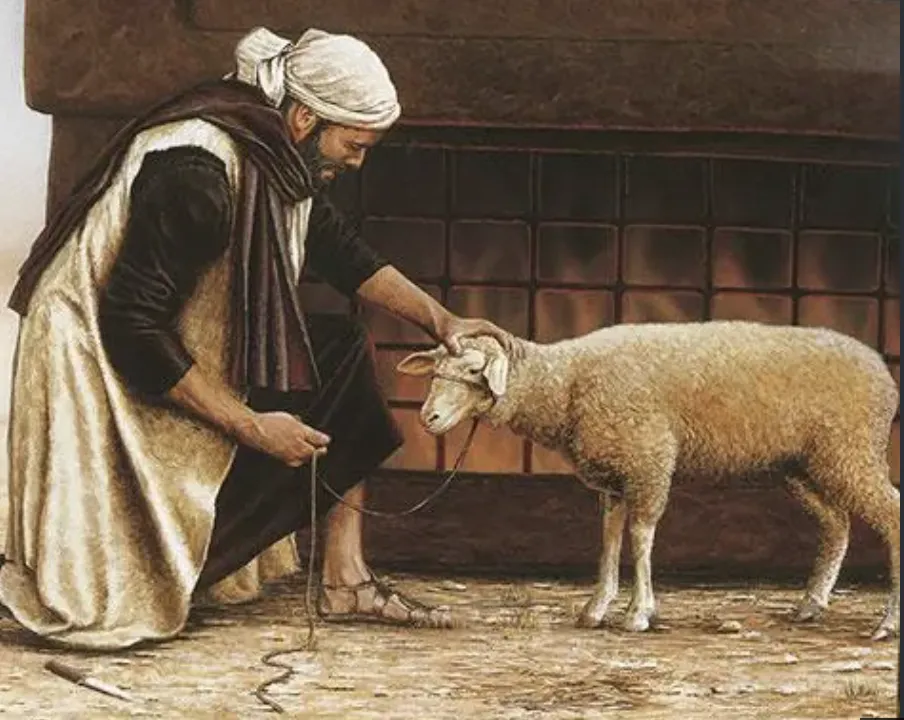
Sacrifice as a Meal
Sacrifice as a Meal
“At the designated time Cain brought some of the fruit of the ground for an offering to the Lord. But Abel brought some of the firstborn of his flock-even the fattest of them. And the Lord was pleased with Abel and his offering, but with Cain and his offering he was not pleased.”
Genesis 4:3-5
Long before the time the sacrificial system was introduced to the Israelites, the Bible records people offering sacrifices to God. We see here, just four chapters into Genesis, Cain and Abel offering up both livestock and a portion of the food they were growing. But what was this for? When did God ever ask for offerings before the sacrificial system was installed?
Just a few chapters later, after safely enduring the great flood, Noah builds an altar and offers burnt offerings of every kind of clean animal that was on the ark. (Genesis 8:20) Interestingly, the specifications for what made an animal clean or unclean have not yet been laid out, yet Noah chooses only the “clean” ones.
Sacrifice and offerings were ubiquitous in ancient times. As far back as we can trace the comings and goings of humankind, they gathered at sacred places and offered sacrifices to their god(s). One of these sacred gathering places was found in what is now Turkey. This groundbreaking archaeological find shows what worship looked like for ancient hunter-gatherers. Secular scientists for the longest time claimed that religion was a product of people coming together and forming organized societies, a sort of afterthought to help pass the time. But this finding shows the exact opposite. Worship and giving offerings to a god(s) was what first brought people together, and eventually led to building cities around these sacred sites.
Today, the term sacrifice is commonly understood as something you give up for the sake of someone or something else. Think of soldiers making necessary sacrifices for their country, or new parents sacrificing their time, energy, and sleep for their child. Sacrifice, in its ancient ritualistic context, which is the context of the Bible, centered around a meal. It was not simply about slaughtering an animal so that your sins could be atoned for. Whether it was a domesticated animal, fruit, vegetables, rice, or wheat cakes, what was offered always included food shared among the offerers and the priests. When ancient peoples made sacrifices to their god(s), they were having a meal with the god or goddess.
To make this more concrete, let's take a look at some Old Testament passages.
Just before Moses and the Israelites were freed from Pharaoh's tyranny and the gods of Egypt, God instructs them to take part in the Passover meal. Each family was to take a lamb, slaughter it, cook it over a fire, and, of course, eat it! The blood on the doorposts distinguished them from the Egyptians, marking them as the people of Yahweh, not the people of the gods of Egypt. This meal is both a festival (Exodus 12:14) and a sacrifice(Exodus 12:27). In the years to follow, the people of Israel were to ritually partake in the Passover meal as both a festival and offer it as a sacrifice to the Lord.
Another passage where we can clearly see that sacrifice was an act of communion with God and the people is in Leviticus 7. In verses 11-15, the Israelites are instructed on how to offer sacrifices of well-being/thanksgiving. The offerer brings his wheat cakes, unleavened bread, oil, and whatever meat is being offered for that sacrifice. A portion of all that is offered goes to the Lord, a portion goes to the priest, and a portion goes to the one who offered the sacrifice. What God wanted from His people Israel through sacrifice was not substitution, that is, an animal takes on the guilt of their sin instead of them, but to maintain communion. Whether it was a thanksgiving offering of grain or wheat cakes, or a sin offering given by a priest (Leviticus 6:26), these were acts of communion with God.
Some have purported that the main reason for the sacrificial system was to maintain the justice of God by substituting ourselves with an animal. Through this lens, the way that sin is dealt with is by the death of an animal instead of the death of the sinner. But if we read the Old Testament carefully, this paradigm is not there. There is not a single verse in the Old Testament where the sins of a person are placed on an animal, and then that animal is sacrificed to God. If the sins of a person were transferred to an animal, it would be unclean and unfit as a sacrifice to God. The only time the sins of the people are ritualistically placed on an animal is on the Day of Atonement(Leviticus 16:21-22). Most important to note here is that the goat that the people’s sins are placed upon is not killed; it is sent out into the wilderness to take the sins away from the people and the tabernacle. The blood of the goat sacrificed on the Day of Atonement is used to cleanse the tabernacle from the taint of the people's sin.
Having the proper idea of sacrifice, the way that the people participated in it, and its ultimate purpose radically changes the way that we read the Old Testament. From the very beginning pages of Genesis, we see Cain and Abel offering sacrifices to God. Noah takes two of each clean animal and communes with God through sacrifice. The Israelites, when they were faithful to do so, maintained their communion with God through the sacrificial system. Sacrifice, in its original context, was an act of hospitality to honor and help form and maintain relationships within the community.
All of the Old Testament examples of sacrifice and keeping communion with God were only images and types of the true means of communion with God. All of it was pointing somewhere, rather, to Someone.
At the end of Jesus’s earthly ministry, just before His crucifixion, He celebrates Passover with His disciples. He takes the bread and says to them, “Take, eat: this is my body.” He takes a cup, gives thanks, and offers it to them, saying, “Drink from it, all of you; for this is my blood of the covenant, which is poured out for many for the forgiveness of sins.” (Matthew 26:26-28) What began in the fire-lit huts in the plains of Goshen just before the Israelites were freed from Egypt is fulfilled when Jesus gave His body and blood for the forgiveness of sins. This was the ultimate sacrifice that we, as His sons and daughters, get to participate in by communing with Him through holy communion. There is none like our God, who came down to rescue us by offering up Himself as the perfect sacrifice, destroying the record of our sins and making us holy.
The most holy sacrifice became for us the most holy meal. For his flesh is true food, and his blood true drink. (John 6:55) And those who take part of this sacred meal shall have eternal life.